See what happened—and why.
Review the trade and the session together. Connect grades, notes, screenshots, setup rules and the commitment you carried forward.
The TradeTattva Journal toolkit
Journal keeps performance and process connected—from the plan you wrote to the evidence you review after the close.

A connected review system
Lead with the questions traders actually ask. Keep the full capability list available without making every feature compete for equal attention.
Review the trade and the session together. Connect grades, notes, screenshots, setup rules and the commitment you carried forward.
Expectancy, uncertainty, sample size and strategy comparisons share one scale.
See adherence, risk lines, trade caps and incomplete review evidence over time.
Go from headline to evidence
Each view keeps its scope, sample size and assumptions visible, so a useful comparison does not become false precision.
Break results down by time, setup, instrument, weekday, holding period and trade order.
Explore performance →Read expectancy ranges, rule adherence and decay together. Small samples stay visibly uncertain.
Explore strategies →Exclude one historical slice and compare the remaining record with the original baseline.
Explore What-if →The complete workflow
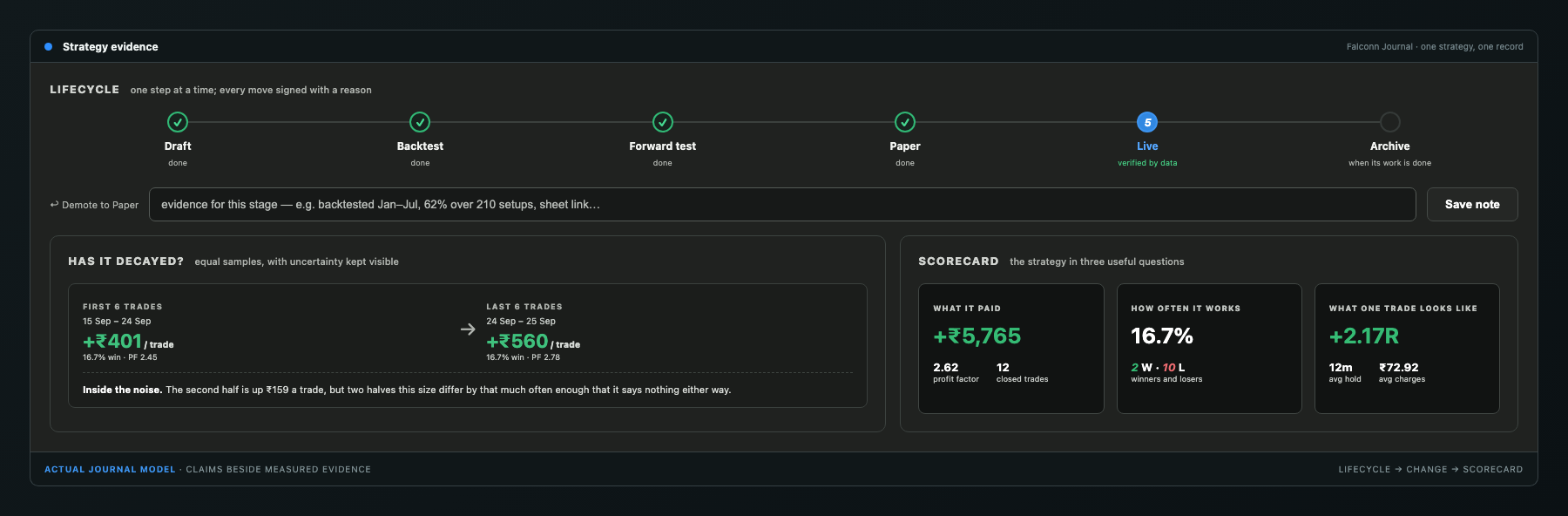
Lifecycle evidence, equal-sample decay checks and the scorecard stay together—so a result never loses the history and assumptions behind it.

Write the decision before the outcome can rewrite your memory.
Record entry, invalidation, target, session-window and skip rules with revision history.
Judge each trade against the rule set that existed when it was taken.Write the watchlist, intended setups, market context and session risk before the open.
Separate a planned decision from an explanation written afterwards.Keep dated loss, trade-count and risk limits beside the sessions where they applied.
See when a limit broke and what happened after the breach.Keep broker accounts scoped, preserve source records and export a portable journal.
Compare accounts without mixing their histories or losing your data.Turn a history of trades into bounded, comparable evidence.
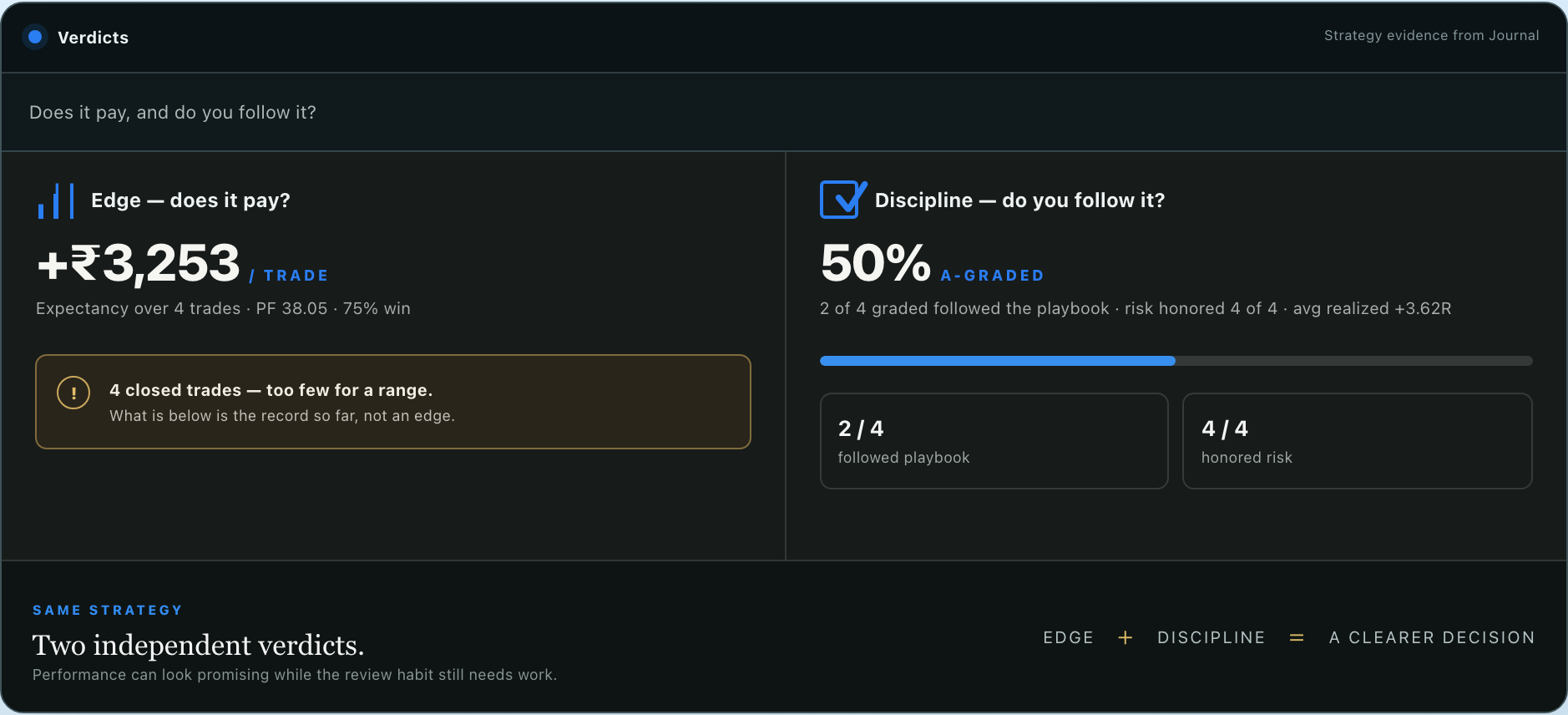
Track strategy edge and recorded discipline as separate dimensions through time.
Know whether results changed, execution changed, or both changed.Break net results down by setup, time, instrument, weekday, hold and trade order.
Find where gains and losses actually concentrate.Keep expectancy and rule adherence beside their sample sizes and uncertainty.
Distinguish a weak strategy from a sound strategy traded poorly.Compare option type, strike relation, expiry distance, premium and holding time.
See which contract choices help or hurt the recorded outcome.Trace gross P&L through allocated or estimated charges to the amount retained.
Know whether a profitable-looking approach survives its trading costs.Place expectancy ranges, samples, adherence and trends on one common scale.
Compare plays without turning small samples into false rankings.Connect outcomes to decisions and carry one useful lesson forward.
Keep grades, notes, screenshots, rule answers and next commitments together.
Reconstruct what you decided without relying on outcome-coloured memory.Inspect early exits, stop changes, sizing after losses and behaviour within a session.
Identify the recurring action that costs the most.Compare changing returns with changing adherence across equal trade samples.
See whether deterioration belongs to the strategy or its execution.Remove one historical slice and compare the remaining record with the baseline.
Check a bounded hypothesis without rewriting the original history.Bring results, adherence, incomplete evidence and one next action into a recurring review.
Turn isolated observations into a repeatable improvement habit.Start with your own evidence
Import a supported tradebook, add a trade manually or explore sample data.